The 30-yard is the right call when debris volume is high but the material is relatively light and bulky rather than dense. If a job is a single-room remodel or a garage declutter, a 10-yard ($595) or 20-yard ($695) is…
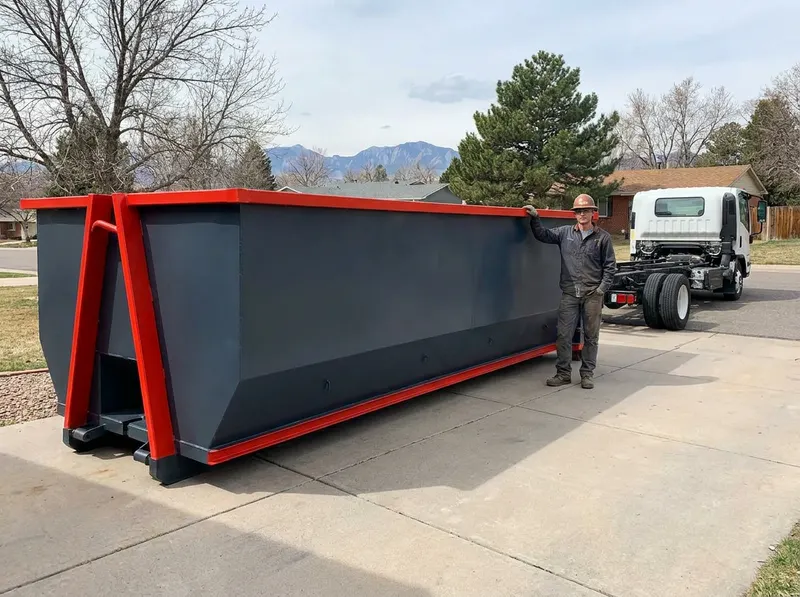
The 30-yard is the right call when debris volume is high but the material is relatively light and bulky rather than dense. If a job is a single-room remodel or a garage declutter, a 10-yard ($595) or 20-yard ($695) is enough; if a project is a whole-house gut or a two-layer roof tear-off, the 30-yard ($795) carries far more in one haul and saves a second rental. For the heaviest loads, concrete, dirt, brick, or roofing in bulk, a 40-yard ($895) adds reach, though dense debris can hit weight limits before the box fills. The trade-off is simple: a larger box costs more up front and takes more driveway, but one 30-yard often replaces two smaller hauls on a cleanout.
Driveway and street placement matter in older Denver neighborhoods. In Capitol Hill, Baker, and the Highlands (LoHi), lots are narrow and alley access is common, so a 22-foot box needs a clear, flat stretch to set down without blocking a neighbor. Wider driveways in Stapleton (Central Park), Park Hill, and parts of Montbello usually hold a 30-yard with room to park beside it. Ridgeback Dumpster Rental sets the container on boards to keep concrete and asphalt driveways from scuffing. If the dumpster must sit on a public street or in a right-of-way near Washington Park, Cherry Creek, Berkeley, or Sloan's Lake, the City and County of Denver requires a permit through the Department of Transportation & Infrastructure (https://www.denvergov.org/Government/Agencies-Departments-Offices/Agencies-Departments-Offices-Directory/Department-of-Transportation-Infrastructure), a driveway placement needs no permit.
A dumpster rental is not junk removal: the container is dropped at the address and the customer loads it, which is why the flat price stays low. Step 1, confirm the size and the drop spot by phone or by texting a photo. Step 2, the roll-off is delivered, typically within 24, 48 hours, and set on protective boards. Step 3, the box is filled, level with the top rail, never mounded, so it stays legal and safe to haul under federal load-securement rules (https://www.fmcsa.dot.gov/regulations/cargo-securement/cargo-securement-rules). Step 4, a call or text schedules pickup. Step 5, the full container is hauled to a permitted transfer station and the disposal is handled.
Sorting debris before loading keeps the job clean and the load legal. Shingles, lumber, drywall, and metal belong in the box; recoverable building materials can be diverted through programs listed on Earth911 (https://search.earth911.com/). Paint, solvents, automotive fluids, and similar household hazardous waste must go to a designated drop-off rather than the dumpster, as outlined by the EPA (https://www.epa.gov/hw/household-hazardous-waste-hhw) and the Colorado Department of Public Health & Environment (https://cdphe.colorado.gov/hm/household-hazardous-waste). Electronics are banned from Colorado landfills and must be recycled (https://cdphe.colorado.gov/recycle-electronics). Appliances with refrigerant require separate handling under EPA Section 608 rules (https://www.epa.gov/section608). On a jobsite, keeping the loading zone and walking paths clear follows OSHA housekeeping guidance (https://www.osha.gov/housekeeping), and construction-debris estimates follow the CDRA's framework for C&D material (https://cdrecycling.org/). Mixing a prohibited item into the load can trigger a return fee, so the item list is worth a look before loading starts; the U.S. Fire Administration notes that items like lithium batteries (https://www.usfa.fema.gov/) do not belong in general waste.
Every job gets a firm, written price after an on-site visit.
Tell us about your 30-yard dumpster job in Denver and we'll send a clear, written quote, usually the same day.
 Ridgeback Dumpster Rental